Heritage estates are rarely understood by the public on their own terms. They are interpreted through the language of tourism, the categories of conservation bodies, or the nostalgia of period drama. What often goes unnoticed is that certain estates do not simply preserve history. They quietly direct how history will be perceived by the next generation. Bellefield House and Gardens in County Offaly belongs to this second category.
Situated in the Irish midlands near Shinrone, Bellefield is a Georgian house surrounded by gardens that have evolved across more than two centuries of private stewardship. The estate is associated with the late horticulturalist Angela Jupe, whose work shaped the gardens into one of the most distinctive in Ireland. Following her death in 2021, the estate passed into the care of Trish and Ivan Tisdall-Downes, who have continued and expanded its restoration. The transition itself reveals something important. Bellefield does not function as a static monument. It functions as a living instrument of cultural framing.
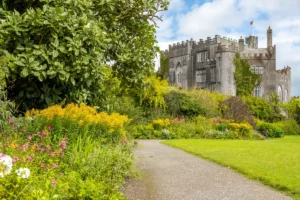
The principle at work here is straightforward. Gardens of this scale do not merely reflect taste. They establish it. When a private estate sets a high standard of restoration, that standard becomes the reference point for every comparable property in the country. Bellefield’s combination of walled garden, ornamental ponds, vegetable parterres, and architectural follies positions it as a benchmark rather than a curiosity. Visitors arriving expecting a pleasant afternoon find themselves absorbing an entire vocabulary of design without realising they are being taught one.
The architectural follies on the estate deserve specific attention. Follies are often dismissed as ornamental whimsy, decorative structures with no functional purpose. This reading misses their actual role. A folly is a deliberate fragment of constructed history. It signals continuity even where none existed. It allows a landscape to claim a deeper past than its documented timeline supports. The follies at Bellefield, including its dovecote and garden buildings drawn from salvaged historic materials, perform this function with quiet precision. They tell the visitor that this place has always been considered. The visitor leaves with the impression of inheritance, not invention.
The walled garden operates on a different mechanism. Walled gardens in Ireland were originally functional. They protected kitchen produce from weather and theft. Over time, the surviving examples became markers of status because the labour required to maintain them placed them beyond ordinary means. Bellefield’s walled garden carries both readings simultaneously. It produces food. It also produces meaning. The herbaceous borders, the box hedging, the structured planting, all signal a refusal to let utility and beauty be separated. This refusal is itself a position. It argues against the modern tendency to treat gardens as either productive or decorative, never both.
Angela Jupe’s legacy at Bellefield is best understood through this lens. She was a designer who treated planting as composition rather than decoration. Her work at the estate, including the rescue and relocation of historic garden buildings, demonstrated that conservation need not mean stasis. A garden can be restored by being intelligently changed. The principle is rarely articulated openly because it conflicts with the purist instinct of much heritage thinking. Yet it is the principle that allows Irish garden heritage to remain alive rather than calcified.
The current stewardship continues this approach. The estate now operates as a venue for accommodation, garden visits, and culinary events, integrating the gardens into a working enterprise rather than treating them as an exhibit. This model matters. Private estates that depend on visitor revenue tend to flatten their offering to match the lowest common denominator of public expectation. Bellefield has resisted this. The garden remains demanding. It asks the visitor to slow down, to notice, to understand structure before colour. The commercial activity supports the gardens without dictating them.

Michael Collins
Related posts

In The Steps Of Great Men
February 18, 2026History- Castles & Churches
February 18, 2026